
Musical instruments
How did we make them? When did it happen for the first time?
How to make musical instruments
There are multiple instruments our ancestors built in the Stone Age1, and we’ll explain how to make three of them:
🦴🪈 Bone flute
🐄🪘 Simple drum
🪵🪈 Bamboo flute
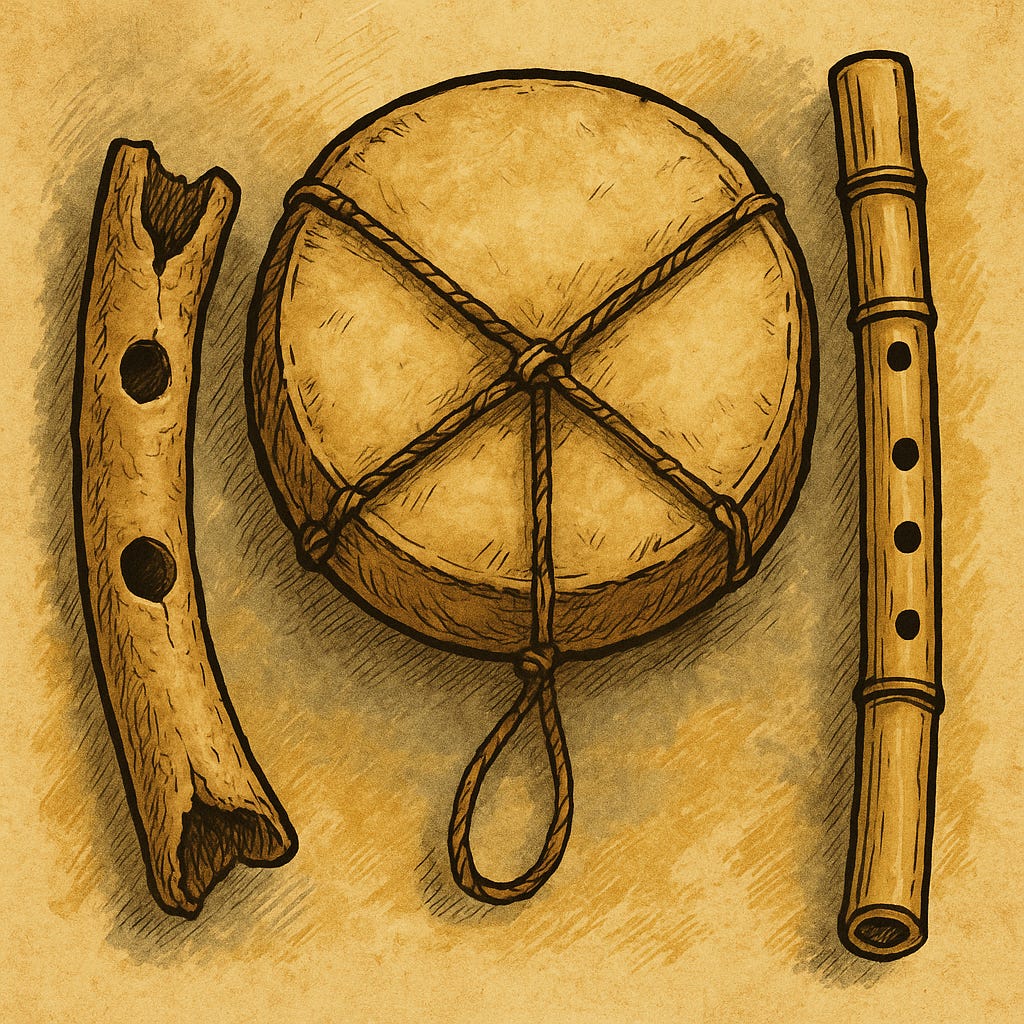
Bone flute
Find a long bone, ideally from a bird or small mammal.
Remove the bone marrow and clean it thoroughly.
Use a pointed stone tool to pierce finger holes at regular intervals.
Carve a notch at one end to direct airflow.
Blow across the opening and adjust hole placement or size to change pitch.
Simple drum4
Find a hollow log or carve out the inside of a thick branch.
Stretch a piece of animal hide over one end.
Tie it securely with rawhide, sinew, or plant fiber cordage.
Let it dry and tighten.
Tap or strike with hands or sticks to play.
Bamboo flute
Harvest a straight section of bamboo, preferably dried.
Cut to a length of 20–30 cm, sealed at one end.
Burn or carve a notch near the closed end for airflow.
Drill 4–6 holes along the side using a hot stick or stone point.
Test and adjust the hole placement for desired tones.
📺 Watch this video for a full tutorial (made with today's tools) on how to make a bamboo flute:
Historic value
The earliest musical instruments were likely percussive: clapping, striking sticks, or drumming on hollow logs. These are accessible, intuitive, and don't require complex construction.
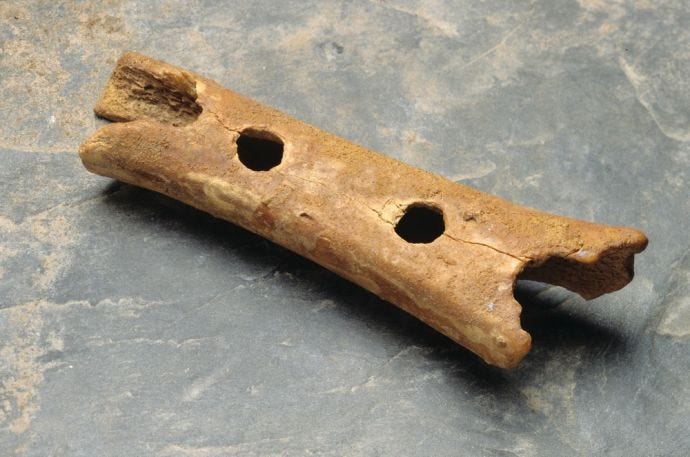
But the oldest complex instrument ever found is the Divje Babe flute2, a 50,000-year-old artifact made from a bear femur, with holes pierced into its side. Found in Slovenia, it’s believed by some to have been made by Neanderthals, though the claim is debated.
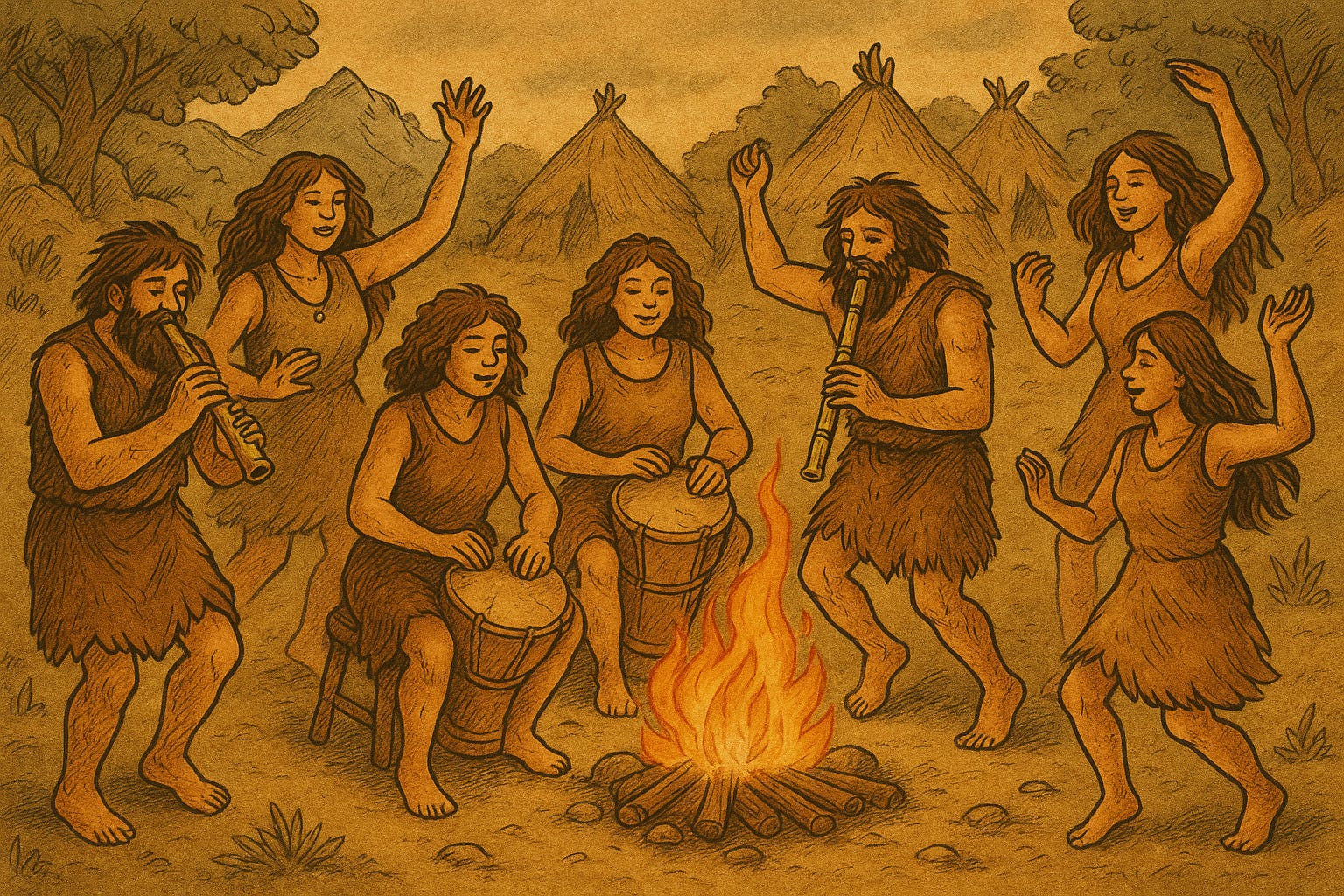
Humans are inherently social, and music is one of our oldest tools for bonding. Instruments gave rhythm to ritual, sound to emotion, and structure to storytelling.
Like painting, music marked a shift in human behavior, from survival to expression. Crafting instruments also required planning, precision, and experimentation, which are big milestones of engineering.
Perhaps most importantly, instruments encouraged practice and play. That meant more dexterity, better focus, and the ability to replicate patterns, all foundational skills in technological advancement.
Impact on technology
Musical instruments may seem like a cultural curiosity, but their technological impact is deeper than it appears:
🧠 Fine motor skills: Building and playing instruments improved hand coordination and control, vital for crafting other tools.
🪚 Tool refinement: Making flutes or drums required precise carving and drilling, encouraging the creation of new tools and techniques.
📐 Pattern recognition: Music is built on repetition and rhythm, which helped train the brain for abstract thinking, planning, and eventually, mathematics.
🛠️ Material science: Experimenting with bone, wood, hide, and bamboo deepened human understanding of acoustics and structural properties.
These first intruments also created the foundations for more complex ones humans created later in time. We will cover some of them in future posts.
And beyond that, music brought us together. It laid the groundwork for group rituals, shared memory, and the birth of culture. In this way, music isn't just entertainment. It’s an early technology of connection.
References
[1] https://nutcrackerman.com/2016/01/12/the-10-oldest-musical-instruments/
[2] https://www.nms.si/en/collections/highlights/343-Neanderthal-flute
[3] https://www.audicus.com/homo-sapiens-musicus-or-why-humans-make-music-2/