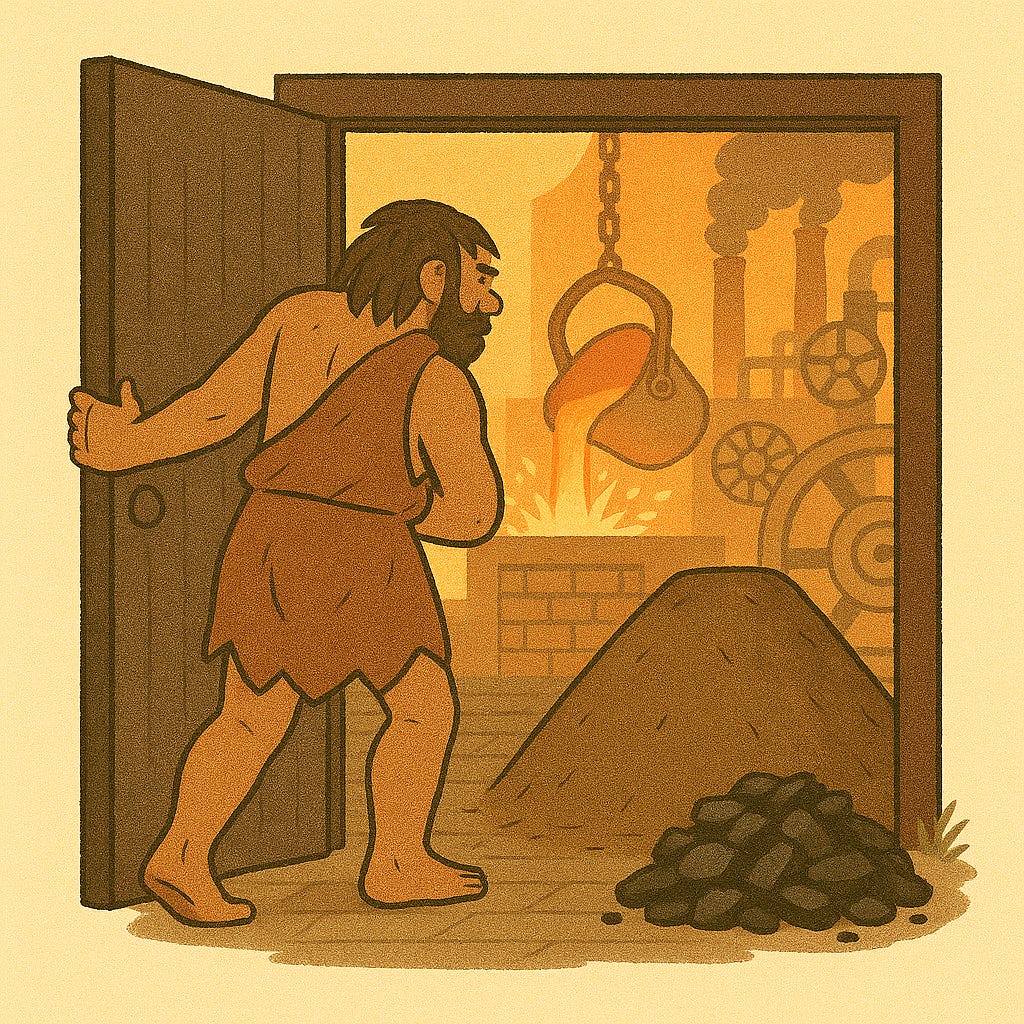
Charcoal
How did we make charcoal? When did it happen for the first time?
How to make charcoal
Charcoal is made by burning wood in a low-oxygen environment, a process called pyrolysis. When done correctly, this removes water, resins, and volatile gases from the wood, leaving behind mostly carbon, a lightweight, black material that burns hotter and cleaner than raw wood.
One of the oldest and simplest methods to make charcoal is the charcoal pile, used for thousands of years in many cultures:
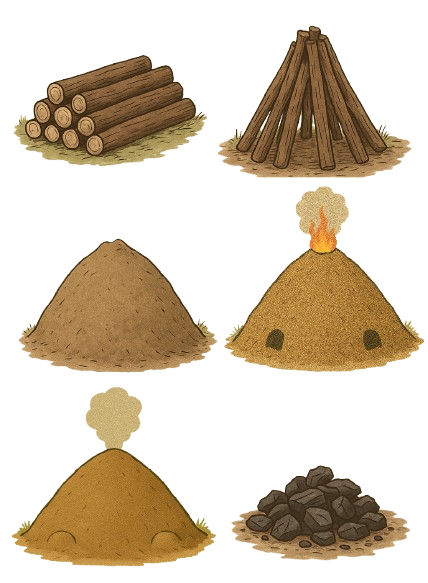
To make a charcoal pile, follow these steps:
🌳 Select your wood: Use dry, dense hardwood like oak, beech, or hornbeam. The wood should be cut into pieces of roughly similar size.
🪵 Build the pile: Stack the wood in a conical shape, standing pieces vertically or leaning inward. Leave a narrow central shaft (like a chimney) and a few ventilation tunnels near the base.
🌿 Cover the pile: Once your stack is ready, cover it with layers of insulating material like grass, leaves, and earth. This isolates the interior, not allowing oxygen to enter and slowing the burn.
🔥 Light the fire: Ignite the central shaft with kindling. The fire will spread slowly outward through the pile.
🌬️ Control the burn: Monitor the vents at the base. If there’s too much smoke or flame, close the vents slightly. The goal is to maintain smoldering, not open flame.
⏳ Wait: The burn takes several hours to days, depending on the pile size. You’ll know it’s done when the smoke becomes bluish and thin.
❄️ Cool it down: Seal the vents and let the pile cool completely before opening it. This prevents the charcoal from catching fire when exposed to oxygen.
🧱 Harvest the charcoal: When the pile is cool, uncover it and remove the charcoal. It should be black, light, and ring like ceramic when struck.
📺 Watch this hands-on demonstration of traditional charcoal-making:
Historic value
Charcoal was likely discovered accidentally, as a byproduct of campfires covered with soil or ash to control the flame or preserve embers overnight. Early humans may have stumbled upon pieces of partially-burned wood that were blackened, lighter, surprisingly flammable and kept burning longer than regular wood.
Over time, they learned to intentionally replicate this effect. Some of the earliest evidence of charcoal use goes back over 30,000 years, in cave paintings where charcoal sticks were used as pigment. But the systematic production of charcoal likely began during the later Stone Age, as fire use became more sophisticated.
Compared to raw wood, charcoal offers several key advantages:
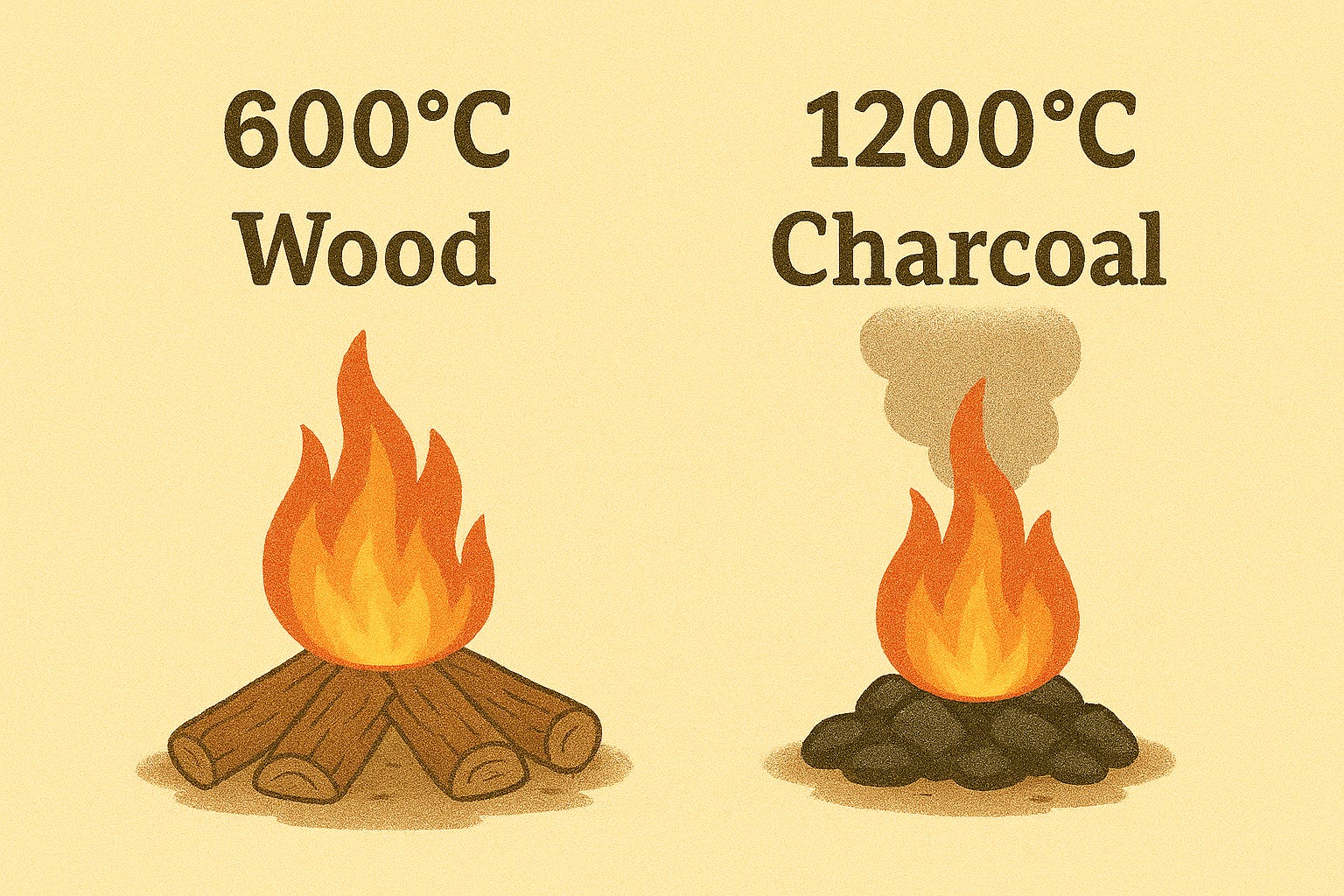
It burns hotter (up to 1100°C in open air, compared to ~500°C for wood).
It produces less smoke and fewer impurities.
It's lighter and easier to transport.
It stores well and resists rotting.
These qualities made it ideal for cooking and heating.
Impact on technology
Charcoal was one of the essential discoveries to the Metal Age.
Why? Because smelting metal ores like copper, tin, or iron requires temperatures far beyond what a wood fire can achieve. Wood alone can't reach the necessary 800–1200°C, but a charcoal fire, especially when fed with air via bellows, can.
Without charcoal, humans couldn’t have:
⛏️ Extracted pure metal from rock.
🥉 Created bronze, an alloy of copper and tin.
⚔️ Forged iron tools and weapons, which defined the Iron Age.
It also had other applications: as a filtering agent, in medicine, and even for making gunpowder much later. But most importantly, charcoal turned the fire from a survival tool into a true engine of transformation.
In this way, charcoal isn't just a fuel, it’s a technological gateway.